Kotick's fight for the new rookery
The Jungle BookKotick's fight for the new rookery is the turning point of Kotick's campaign to save the seals from human killing. After witnessing the slaughter at the killing-grounds and searching the Pacific for a refuge inaccessible to men, Kotick returns with knowledge of a hidden island reached through the Sea Cow's tunnel. The seals dismiss his discovery until he challenges them to follow him if he can defeat them; by winning a devastating battle against the beach's strongest fighters, he changes a private vision of safety into a collective decision to migrate.
Causes and Background
Kotick's challenge grows out of a conflict between the established life of the seal nurseries and the violence that sustains it. Novastoshnah offers excellent accommodation for seals, and every spring hundreds of thousands arrive from the cold gray sea. Sea Catch, Kotick's father, is a massive fifteen-year-old fur seal who returns each spring to fight for a place near the water, where he can establish a nursery. The struggle is regulated by the Rules of the Beach: Sea Catch fights for room, but does not pursue a beaten seal. Even this rough order, however, cannot protect the herds from people who drive them to the killing-grounds.
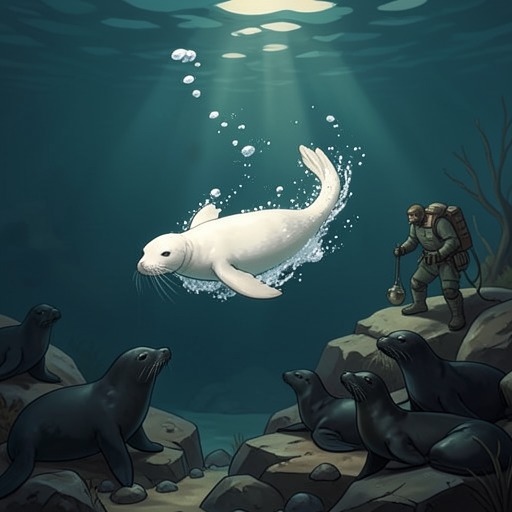
Kotick's understanding changes when he follows the drove toward the killing-grounds. The short distance takes an hour because the seals must be kept cool; if they become overheated, their fur will come off in patches when they are skinned. At the Salt House, men separate selected seals, then kill them with iron-bound clubs. Within minutes Kotick no longer recognizes his companions, whose skins have been ripped from nose to hind flippers and thrown into a heap. He escapes to the sea in horror, but the other seals refuse to sympathize because they regard the driving as ordinary work and have not witnessed what he saw. His difference is intensified by the fact that he is a white seal.
Sea Catch and Matkah advise acceptance rather than resistance. Sea Catch tells his son to grow large, fight for a nursery, and wait until he is old enough to be left alone; Matkah says that Kotick cannot stop the killing and should return to play in the sea. Their advice defines the limits of the old solution: individual strength may win a place on the beach, but it cannot make the beach safe. Kotick therefore leaves alone in autumn, determined to find Sea Cow and a firm, quiet island where men cannot reach the seals.
Discovery and Return
Kotick searches from the North Pacific to the South Pacific, swimming as much as three hundred miles in a day and a night. He narrowly escapes several sharks and examines islands that initially appear promising. Yet every good beach carries evidence of danger: a whaler's smoke on the horizon, or signs that seals once lived there and were killed. Even Kerguelen Island, recommended as a peaceful refuge by an old stumpy-tailed albatross, nearly destroys him against black cliffs in a storm, and it too bears traces of a vanished nursery.
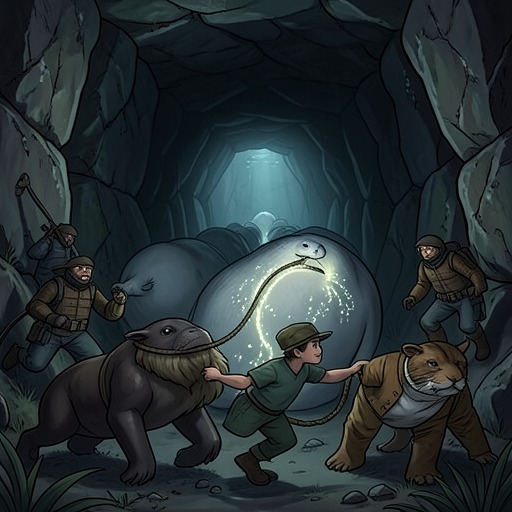
At last Kotick finds the hidden route that makes the new rookery viable. He discovers the mouth of the Sea Cow's tunnel, dives through it, and reaches the new country beyond the cliffs. The entrance is so concealed that even Kotick can scarcely believe he has passed beneath the rocks. He spends six days returning to Novastoshnah, not because he is swimming slowly but because the journey is long, and the first seal he meets sees from his eyes that he has finally found the island he sought.
The discovery does not immediately persuade the community. Sea Catch, the holluschickie, and the other seals laugh when Kotick reports it. A young seal argues that Kotick has no right to order them away from nurseries for which they have fought, accusing him of merely prowling about in the sea. Kotick answers that he has no nursery to defend and wants only to show them a place where they will be safe. The disagreement turns on competing definitions of duty: the young seal measures belonging by fighting for property already possessed, while Kotick measures it by finding protection for everyone.
The Challenge and Battle
When the young seal suggests that Kotick is backing out, Kotick asks whether he will come if Kotick wins. The promise transforms the argument into a test whose terms the community can understand. Kotick does not seek the fight for its own sake; he accepts it because the seals will not trust an untested outsider's report. His anger is therefore joined to a practical objective: victory must become proof of the value of the new rookery.
The fight begins abruptly. Kotick sinks his teeth into the young seal's neck, throws himself backward, hauls his opponent down the beach, shakes him, and knocks him over. He then declares that he has spent five seasons doing his best for the seals and has found an island where they will be safe, but that they will not believe him until they are forced to recognize his strength. The speech is not a request for admiration. It is an ultimatum born from the community's refusal to act on knowledge alone.
Kotick charges into the nurseries and attacks the largest sea catch he can find. He catches one by the throat, chokes, bumps, and throws him aside, then turns on the next. His physical condition gives him an unexpected advantage. Unlike the older fighters, he has not fasted for four months, and his deep-sea journeys have kept him in perfect condition. More importantly, he has never fought before, so he has not been shaped by the customary rhythm of beach combat. His inexperience becomes a source of unpredictability, while his white mane, blazing eyes, and large dog teeth make the force of his assault visible across the beach.
Sea Catch first watches Kotick tear through the older seals and scatter the young bachelors. He then acknowledges that, whatever Kotick's judgment may be, he is the best fighter on the beaches, and warns him not to attack his father. Sea Catch joins him, with his mustache raised and his breath laboring, while Matkah and Kotick's prospective mate remain crouched down and watch. Father and son fight side by side until no seal dares raise his head; afterward they parade along the beach together, bellowing. The battle thus becomes both a public contest and a family alliance, replacing the father's earlier counsel of patience with active support for Kotick's larger purpose.
Consequences and Collective Decision
By nightfall, under the flickering Northern Lights and through the fog, Kotick surveys scattered nurseries and wounded seals from a bare rock. He announces that he has taught them their lesson. Sea Catch, badly mauled, replies that even the Killer Whale could not have cut them up worse, but expresses pride in his son and agrees to accompany him if the island exists. The acknowledgment matters because the old patriarch's approval gives Kotick's expedition legitimacy within the community.
Kotick then addresses the seals as a collective body and demands to know who will come with him to the Sea Cow's tunnel. His threat to teach them again is harsh, but it follows the community's chosen standard of authority: the seals have trusted fighting more readily than testimony. The answer rises along the beaches like the ripple of the tide. Thousands of tired voices agree to follow Kotick, the White Seal. The value at stake shifts from endangered security to collective safety; the new rookery is no longer merely Kotick's discovery but the future destination of the seal people.
The victory leaves Kotick physically transformed by the violence he has used on behalf of peace. He is red from head to tail, though he remains too proud even to look at or touch his wounds. The scene's final contrast is therefore central to its meaning: Kotick must become the greatest fighter on the beaches in order to end the seals' dependence on the contested beaches. His battle does not glorify domination as an end in itself. It is a forced demonstration that converts resistance, ridicule, and inherited custom into consent to migration.